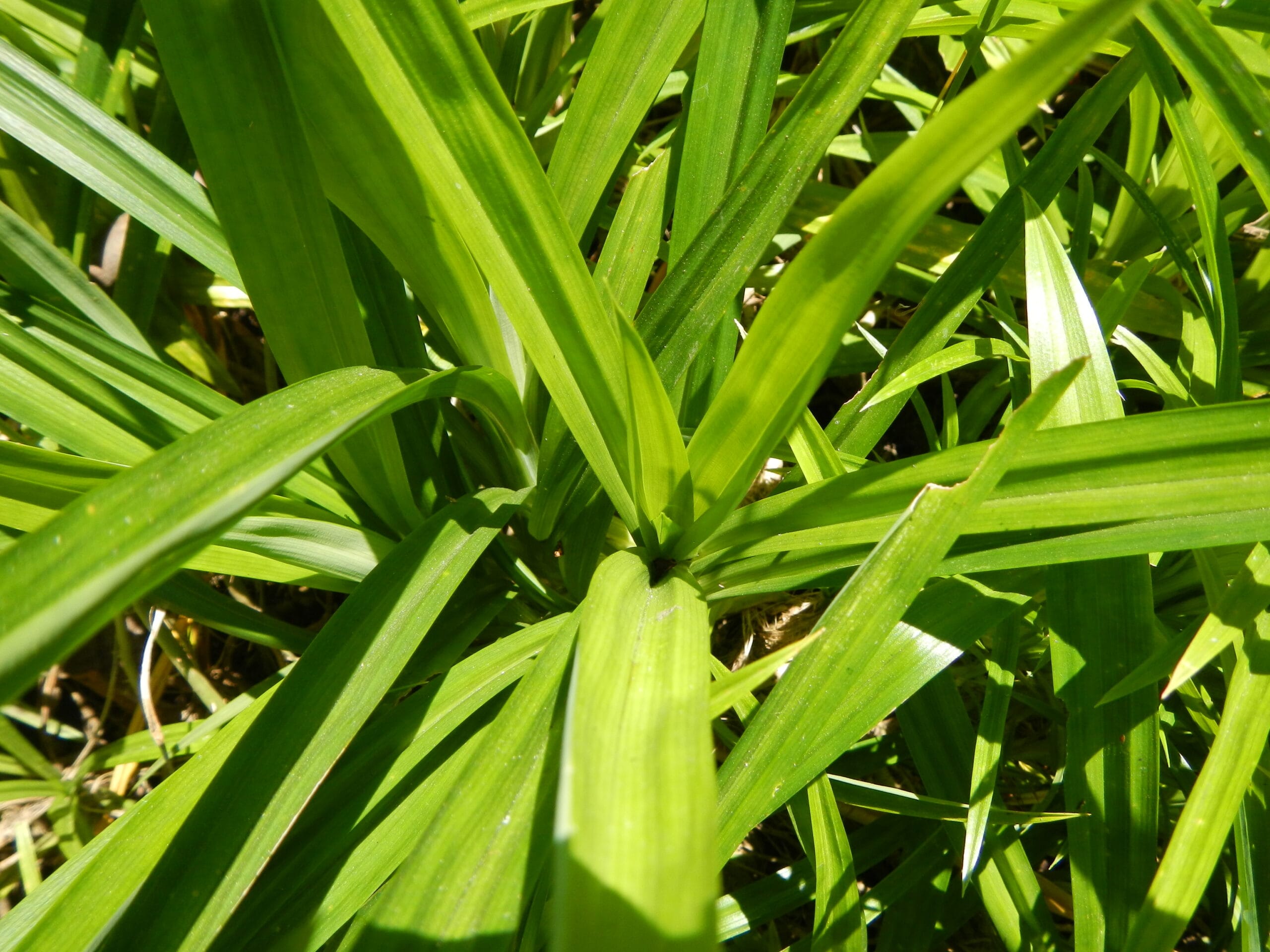
Pandan is one of the most familiar aromatic plants in Filipino and Southeast Asian cooking. Its long green leaves are used to fragrance rice, desserts, drinks, and many traditional foods.
There is one important detail about pandan in the Philippines, though. Pandan lalaki and pandan-mabango can refer to different species.
The fragrant pandan commonly used in cooking is Pandanus amaryllifolius, known in the Philippines as pandan-mabango, or fragrant pandan. Philippine ethnobotanical research has also documented other local names for this species.
Pandan-lalaki, meanwhile, is documented in Philippine ethnobotanical research as a local name for Pandanus luzonensis, a different pandan species native to Luzon.
This distinction matters because the two plants have different characteristics and uses.
This guide focuses primarily on pandan-mabango (Pandanus amaryllifolius), the aromatic pandan used in Filipino cooking, while explaining the difference between it and pandan-lalaki.
Pandan Quick Facts
| Feature | Details |
|---|---|
| Common culinary name | Pandan, pandan-mabango |
| Other common names | Fragrant pandan, fragrant screwpine |
| Scientific name | Pandanus amaryllifolius Roxb. |
| Family | Pandanaceae |
| Native range | Maluku, Indonesia |
| Status in the Philippines | Introduced and cultivated |
| Growth form | Fragrant shrub-like plant |
| Main useful part | Leaves |
| Leaf characteristic | Long, narrow, green, strongly aromatic |
| Signature aroma compound | 2-acetyl-1-pyrroline (2-AP) |
| Main uses | Rice, desserts, drinks, flavoring, and food coloring |
| Propagation | Suckers and stem cuttings |
| Light | Shade-tolerant; partial shade works well |
| Water | Consistent moisture with good drainage |
Kew recognizes Pandanus amaryllifolius as an accepted species and gives its native range as Maluku. The plant is now cultivated across many parts of Southeast Asia, including the Philippines. (Kew Plants of the World Online)
What Is Pandan Mabango?
Pandan-mabango means fragrant pandan.
It refers to Pandanus amaryllifolius, the aromatic pandan widely used in Southeast Asian cooking.
The plant’s long leaves are valued mainly for their fragrance. They can be added whole to rice or other dishes and removed after cooking, or they can be processed into juice, paste, powder, or extract for recipes.
The University of Santo Tomas Plant Database identifies Pandanus amaryllifolius as pandan-mabango and describes its fragrant leaves as widely used in Filipino and Southeast Asian food.
Is Pandan Mabango the Same as Pandan Lalaki?
No. They can refer to different species.
A Philippine ethnobotanical study published in Economic Botany documented Pandanus amaryllifolius under names including pandan, pandan-mabango, and pandan-babae in the communities studied.
The same study documented Pandanus luzonensis as pandan-lalaki. (Economic Botany)
Pandan-mabango
Pandanus amaryllifolius
This is the fragrant culinary pandan used to scent rice, desserts, drinks, and other food.
Pandan-lalaki
Pandanus luzonensis
This is a different species native to Luzon, Philippines. It has different physical characteristics and traditional uses. Kew recognizes it as a separate species. (Kew Plants of the World Online)
So, when buying pandan specifically for cooking, the scientific name to look for is:
Pandanus amaryllifolius
Where Does Pandan Mabango Come From?
Kew lists Maluku as the native range of Pandanus amaryllifolius. PROSEA describes fragrant pandan as an ancient cultivated plant and suggests the Moluccas as its possible origin. (Kew, PROSEA)
It is now widely cultivated throughout Southeast Asia.
Although pandan is not originally native to the Philippines, it has become deeply established in Filipino cooking and home gardening.
What Does Pandan Look Like?
Pandan-mabango grows as a clumping, shrub-like plant rather than a large tree.
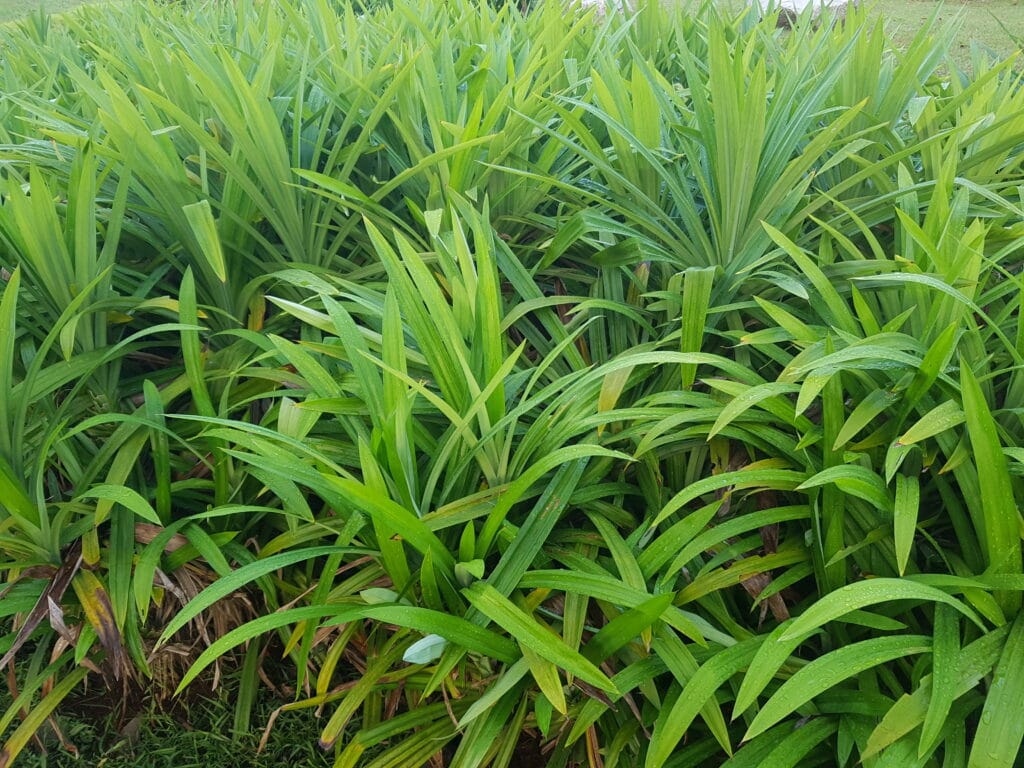
Multiple shoots can develop from the base, gradually creating a larger clump.
Leaves
The leaves are:
- Long
- Narrow
- Green
- Flexible
- Strap-like
- Strongly aromatic
The fragrance becomes more noticeable when the leaves are bruised, cut, or heated.
Unlike many other Pandanus species used for weaving, Pandanus amaryllifolius is particularly valued as a culinary plant because of the aroma of its leaves.
Does pandan produce fruit?
Pandan-mabango is unusual because cultivated plants are generally propagated vegetatively rather than grown from readily available seed.
PROSEA notes that fragrant pandan is an ancient cultivated plant and has not been found growing wild in the typical way expected of many cultivated species. (PROSEA)
For home gardeners, this means suckers and cuttings are much more practical than relying on fruit and seed.
Why Does Pandan Smell So Good?
The distinctive fragrance of pandan is strongly associated with 2-acetyl-1-pyrroline, usually abbreviated as 2-AP.
This volatile compound is also associated with the characteristic aroma of several fragrant rice varieties.
Research has identified 2-AP as an important contributor to the smell of Pandanus amaryllifolius. (Research on pandan aroma)
This is why just a few pandan leaves can noticeably change the aroma of a pot of rice.
Why Do People Put Pandan Leaves in Rice?
The main reason is fragrance.
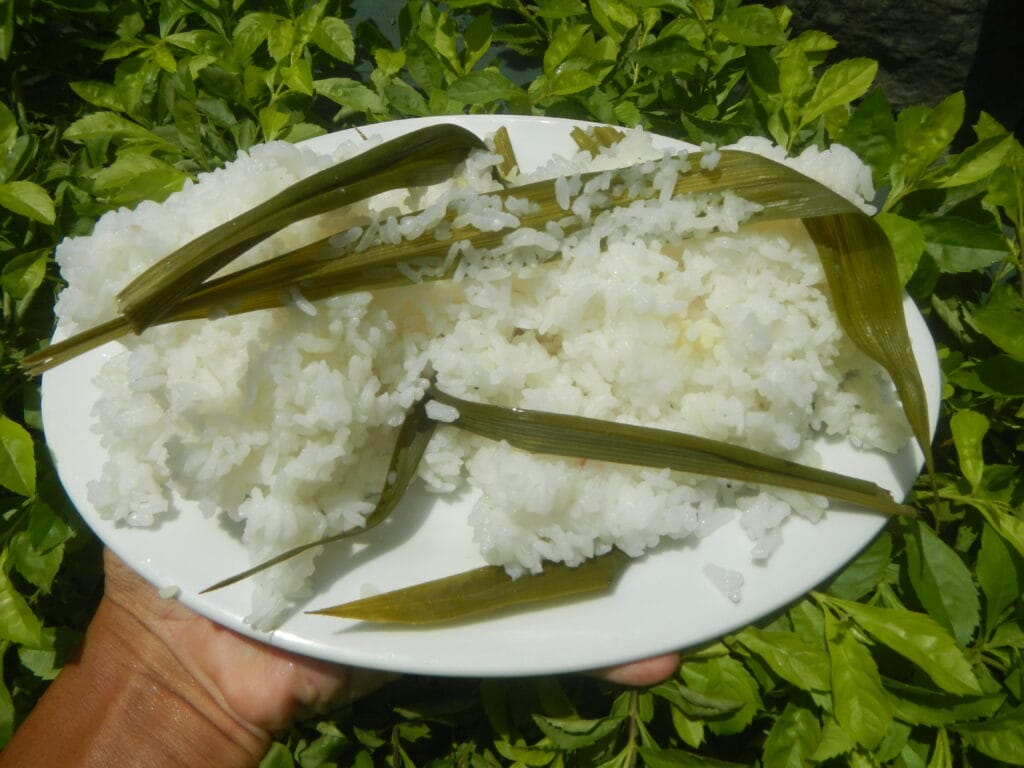
A few washed pandan leaves can be tied into a knot and placed into a rice cooker or cooking pot.
As the rice cooks, the leaves release aromatic compounds into the steam and rice.
The leaves are then removed before serving.
A Philippine ethnobotanical study found that Pandanus amaryllifolius was commonly used as a food and rice flavoring plant in the communities studied. (Economic Botany)
What Are Pandan Leaves Used For?
Pandan is primarily a culinary flavoring and aromatic plant.
Rice
Pandan leaves are commonly added to:
- Plain rice
- Coconut rice
- Fragrant rice dishes
- Rice-based desserts
The leaves add aroma without dominating the flavor.
Filipino desserts
Pandan is widely used in Filipino desserts such as:
- Buko pandan
- Pandan cake
- Kakanin
- Rice cakes
- Jelly desserts
- Custards
- Ice cream
- Sherbets
- Sweet breads
The leaves can provide both fragrance and a natural green color when processed.
Drinks
Pandan can also be used in:
- Pandan tea
- Pandan-infused water
- Sweet drinks
- Coconut-based beverages
- Dessert drinks
Food extracts and powders
Pandan leaves can be processed into juice, extracts, pastes, and powders for use in food products.
Its commercial value comes largely from its distinctive aroma.
Can You Eat Pandan Leaves?
Pandan is an edible culinary plant, but whole mature leaves are generally not eaten like leafy vegetables.
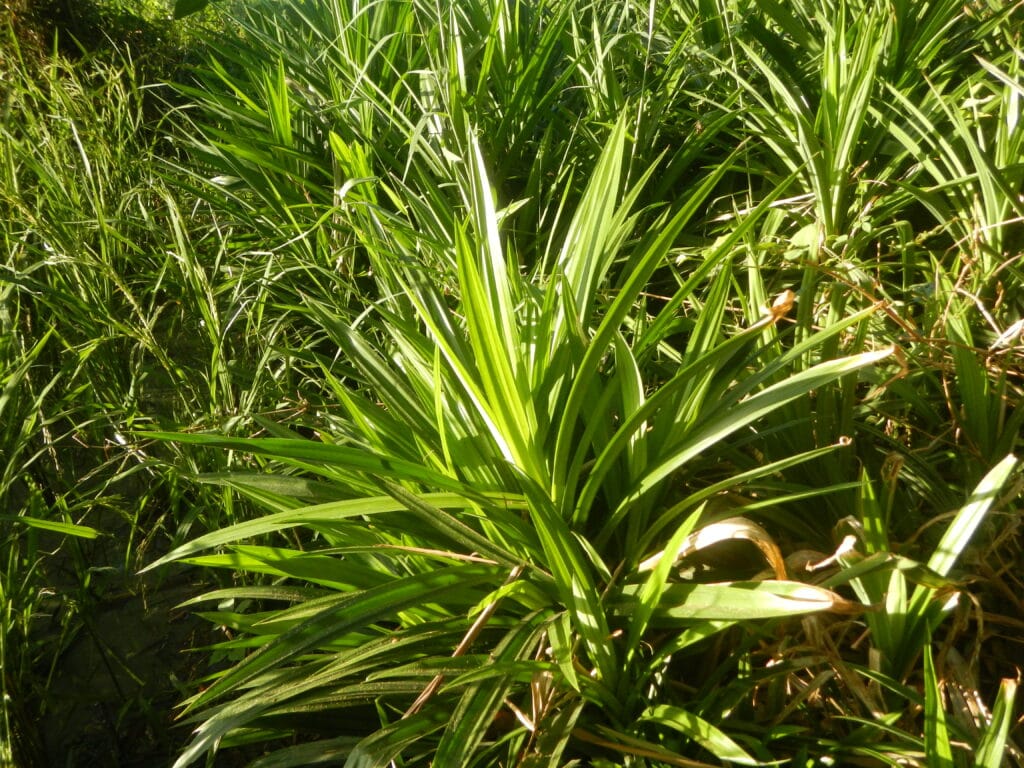
Instead, the leaves are commonly used to infuse food and then removed.
Mature pandan leaves are fibrous and can be unpleasant to chew.
The leaves may also be finely processed or blended when a recipe specifically calls for pandan juice or another pandan preparation.
What Are the Benefits of Pandan?
The most practical benefits of pandan are related to food, fragrance, and home gardening.
1. Adds aroma to food
Pandan gives rice, desserts, and drinks a distinctive sweet, nutty aroma.
This is its most important everyday use.
2. Provides natural food color
Fresh pandan leaves can be processed into green liquid that is used to color certain desserts and other foods.
3. Provides a convenient source of fresh flavoring
Growing pandan at home means you can harvest a few leaves whenever a recipe calls for them.
4. Grows well in tropical gardens
Pandan tolerates shade and thrives in warm, humid conditions, making it particularly practical for tropical home gardens.
5. Can be harvested repeatedly
Unlike a plant harvested only once, an established pandan clump can provide leaves repeatedly when harvested carefully.
PROSEA recommends leaving the growing top with several leaves intact so the plant can continue developing. (PROSEA)
Does Pandan Have Medicinal Benefits?
Pandan has a long history of traditional medicinal use in Southeast Asia, including the Philippines.
Philippine ethnobotanical research has documented traditional uses of Pandanus amaryllifolius for several purposes in rural communities. These include uses associated with stomach discomfort and other traditional remedies. (Economic Botany)
Modern research has also examined pandan extracts for antioxidant, antimicrobial, glucose-related, anti-inflammatory, and other biological activities.
A 2024 review identified more than 100 reported compounds in Pandanus amaryllifolius and summarized the plant’s pharmacological research. A 2026 review likewise describes growing scientific interest in pandan’s phytochemicals and functional-food potential while emphasizing the need for better human research. (2024 review, 2026 review)
That distinction is important.
Traditional use and laboratory research do not automatically prove that pandan treats a disease.
Therefore, claims that pandan tea can cure diabetes, lower blood pressure, detoxify the body, treat infections, or replace prescribed medicine should not be presented as established medical facts.
For readers interested in traditional Philippine herbs, Money For My Beer’s guides to Yerba Buena, Tsaang Gubat, and Lemongrass provide additional context.
Can You Make Pandan Tea?
Yes.
A simple pandan infusion can be made with fresh leaves.
Simple pandan tea
- Wash several fresh pandan leaves.
- Cut or tie the leaves into smaller sections.
- Add them to hot water.
- Allow them to steep for several minutes.
- Strain before drinking.
The result is a mild, aromatic drink.
Pandan tea has traditional use in some communities, but it should be treated as a traditional beverage rather than a proven medical treatment.
Does Pandan Have Nutritional Value?
Pandan contains various naturally occurring plant compounds, including phenolics, flavonoids, carotenoids, alkaloids, and chlorophyll-related compounds.
Recent reviews have also examined dietary fiber and other components of pandan leaves. (2026 review)
However, pandan is normally used in small quantities.
When a few leaves are used to scent a pot of rice, the nutritional contribution is very different from eating a large serving of vegetables.
For this reason, pandan is best thought of as a culinary aromatic plant, not as a major source of daily nutrients.
How to Grow Pandan Mabango
Pandan is well suited to warm, humid tropical climates.
It can be grown directly in the garden or in containers, making it practical even when space is limited.
For broader advice on home gardening, see the Complete Gardening Guide.
Light requirements
Pandan is notably shade-tolerant.
PROSEA describes fragrant pandan as tolerating shade well. (PROSEA)
A location with bright filtered light or partial shade can work well.
In very hot climates, some afternoon shade can help prevent excessive leaf stress.
Soil
Use a moist but reasonably well-drained soil.
Pandan likes moisture, but the root zone should not remain permanently saturated.
For container growing, use a potting mix that holds moisture while allowing excess water to drain.
Watering
Keep newly planted pandan consistently moist while it establishes.
Established plants also prefer regular moisture, particularly during hot or dry weather.
Avoid repeatedly allowing the plant to become extremely dry and then soaking it heavily.
The goal is even moisture with good drainage.
Humidity
Warm and humid conditions suit pandan very well.
This is one reason it grows naturally as a useful garden plant throughout much of Southeast Asia.
Growing pandan in a pot
Pandan can be grown successfully in a large container.
Container growing is useful for:
- Balconies
- Patios
- Small gardens
- Kitchen gardens
- Sheltered outdoor areas
Use a container with drainage holes and enough room for the plant to produce new shoots.
How Do You Propagate Pandan?
Pandan-mabango is commonly propagated vegetatively.
The most practical methods are:
- Suckers or offsets
- Stem cuttings
PROSEA specifically documents both methods for Pandanus amaryllifolius. (PROSEA)
Propagating from suckers
Suckers are young shoots that develop around an established pandan clump.
They are generally the easiest option for home gardeners.
To propagate a sucker:
- Select a healthy young shoot.
- Separate it carefully from the parent plant.
- Retain as much of the developing root system as possible.
- Plant it in moist, well-drained soil.
- Keep it consistently watered while it establishes.
Propagating from stem cuttings
Stem cuttings are another option.
PROSEA recommends inserting suitable stem cuttings obliquely into the growing medium. (PROSEA)
Because not every cutting will necessarily root successfully, starting with several healthy pieces is sensible.
How Long Before You Can Harvest Pandan?
Under suitable conditions, pandan can begin producing harvestable leaves at around six months after planting.
PROSEA reports that leaves can then be harvested over several years when the plant is properly managed. (PROSEA)
Growth speed will vary according to the planting material, climate, light, water, soil, and general care.
How Do You Harvest Pandan Leaves?
Harvest individual mature leaves rather than stripping an entire plant.
Cut the leaf close to its base while avoiding damage to the central growing point.
Leave enough healthy foliage for continued growth.
PROSEA recommends retaining the growing top with three to four leaves during harvesting. (PROSEA)
For household cooking, taking only the leaves you need is usually the best approach.
How Do You Store Fresh Pandan Leaves?
For short-term storage, fresh pandan leaves can be kept in the refrigerator.
To help preserve them:
- Keep the leaves clean and relatively dry.
- Wrap them loosely.
- Refrigerate them.
- Check for excess moisture or spoilage.
Pandan can also be frozen for longer storage.
Because the plant’s characteristic fragrance comes from volatile compounds, processing and storage can influence aroma intensity.
Can Pandan Be Grown Indoors?
Pandan can be grown indoors when it receives enough light and warmth.
A bright window or warm indoor growing area is much better than a dark room.
For most homes in the Philippines, a bright patio, balcony, or partially shaded outdoor location will provide more suitable conditions.
Common Pandan Growing Problems
Brown leaf tips
Brown tips can result from dry conditions, inconsistent watering, salt buildup, or general environmental stress.
Check the soil before adding fertilizer.
Yellow leaves
Yellow leaves can be caused by excessive moisture, poor drainage, nutrient problems, or other stress.
If the soil stays wet for long periods, improve drainage rather than simply watering more.
Slow growth
Insufficient light, cold conditions, inadequate water, poor nutrition, or a crowded root system can all slow growth.
Container-grown pandan may also need to be divided when the clump becomes too crowded.
Overcrowded plants
Pandan naturally produces additional shoots.
When a clump becomes too crowded, healthy offsets can be separated and replanted.
This gives you more plants while also helping maintain the original clump.
Is Pandan Easy to Grow?
Generally, yes.
Pandan is a practical tropical garden plant because it:
- Tolerates partial shade
- Likes warm, humid conditions
- Can grow in containers
- Can be propagated from suckers
- Can be harvested repeatedly
Once established, a healthy clump can provide a regular supply of leaves for household cooking.
Pandan in Filipino Cooking
Pandan has a particularly strong place in Filipino food culture.

The leaves are associated with fragrant rice, buko pandan, kakanin, cakes, ice cream, drinks, and many other desserts.
A Philippine ethnobotanical study found Pandanus amaryllifolius to be one of the Pandanaceae plants used as food and particularly as a rice flavoring plant in the rural communities studied. (Economic Botany)
The University of Santo Tomas Plant Database likewise documents pandan-mabango’s widespread use in Filipino and Southeast Asian cooking. (University of Santo Tomas)
For many Filipino households, pandan is simply a useful plant to have growing nearby.
Pandan Lalaki vs. Pandan Mabango
The distinction can be summarized simply:
| Pandan-mabango | Pandan-lalaki | |
|---|---|---|
| Scientific name | Pandanus amaryllifolius | Pandanus luzonensis |
| Philippine status | Introduced and cultivated | Native to Luzon |
| Main form | Clumping, shrub-like plant | Tree |
| Main association | Fragrant culinary leaves | Local Philippine uses and materials |
| Common cooking use | Rice, desserts, drinks | Not the standard culinary pandan |
| Aroma | Strongly fragrant | Different species and characteristics |
The names vary between communities, so scientific names are the safest way to identify the plant.
Kew recognizes the two as separate species, while Philippine ethnobotanical research documents their different local naming patterns. (Kew: P. amaryllifolius, Kew: P. luzonensis, Economic Botany)
Pandan and Other Useful Garden Plants
Pandan is especially useful when grown alongside other plants that provide culinary or traditional value.
For a broader look at growing herbs, vegetables, fruit trees, and useful plants, visit the Complete Gardening Guide.
You can also explore:
Lemongrass (Cymbopogon citratus), another aromatic plant widely used in Asian cooking and herbal drinks.
Yerba Buena (Mentha arvensis), a mint with a very different aroma and traditional uses.
Tsaang Gubat (Ehretia microphylla), another Philippine plant with a long history of traditional use.
Alagaw (Premna odorata), a Philippine plant with culinary and traditional applications.
These plants should not be treated as interchangeable remedies. Each has its own botanical identity, traditional uses, and evidence base.
Frequently Asked Questions About Pandan
What is pandan-mabango?
Pandan-mabango is the Filipino name commonly used for Pandanus amaryllifolius, the fragrant pandan widely used in cooking.
What is pandan lalaki?
Pandan-lalaki is documented as a local name for Pandanus luzonensis in Philippine ethnobotanical research. It is a different species from fragrant pandan. (Economic Botany)
Is pandan lalaki the same as pandan-mabango?
No. In Philippine ethnobotanical literature, pandan-mabango refers to Pandanus amaryllifolius, while pandan-lalaki can refer to Pandanus luzonensis.
What is the scientific name of fragrant pandan?
The scientific name is Pandanus amaryllifolius Roxb.
Is pandan native to the Philippines?
Pandanus amaryllifolius is native to Maluku, not the Philippines. It has been introduced and cultivated in the Philippines. (Kew)
Why does pandan smell so good?
Its characteristic aroma is strongly associated with 2-acetyl-1-pyrroline, or 2-AP, a compound also associated with fragrant rice. (Research on pandan aroma)
Why is pandan used in rice?
Pandan leaves release aromatic compounds during cooking, giving rice a distinctive fragrance.
Can you eat pandan leaves?
Pandan leaves are used as a culinary ingredient, but mature whole leaves are usually used to flavor food and then removed because they are fibrous.
Can you drink pandan tea?
Yes. Fresh pandan leaves can be steeped in hot water to make a simple aromatic drink.
Does pandan tea have medicinal benefits?
Pandan tea has traditional uses, but current scientific evidence does not establish it as a treatment or cure for specific diseases. (PubMed 2026 review)
Does pandan lower blood sugar?
Pandan extracts have been investigated for possible effects on glucose metabolism, but this research does not establish pandan as a treatment for diabetes. (PubMed 2026 review)
Does pandan detox the body?
There is no good basis for presenting pandan as a general detox treatment.
Can pandan grow in the Philippines?
Yes. The warm and humid Philippine climate is suitable for growing Pandanus amaryllifolius.
Does pandan need full sun?
No. Pandan is shade-tolerant and can grow well in partial shade or filtered light. (PROSEA)
Does pandan need a lot of water?
Pandan prefers consistent moisture but also needs reasonably good drainage.
Can pandan grow in a pot?
Yes. Pandan can be grown successfully in a sufficiently large container with drainage.
How do you propagate pandan?
Pandan can be propagated from suckers and stem cuttings. (PROSEA)
How long before you can harvest pandan?
Under suitable conditions, harvesting may begin at around six months after planting. (PROSEA)
How do you harvest pandan leaves?
Harvest mature leaves individually and leave the growing center and enough healthy leaves intact so the plant can continue producing new growth.
Final Thoughts
Pandan is one of those plants that can seem ordinary until you notice how many things it does.
A few leaves can give a pot of rice a distinctive fragrance. The same plant can contribute aroma and color to buko pandan, kakanin, cakes, drinks, ice cream, and many other foods.
There is also a clear scientific reason for its familiar smell. 2-acetyl-1-pyrroline is a major contributor to pandan’s characteristic aroma and is also associated with fragrant rice.
For the home gardener, pandan has another advantage. It is relatively practical to grow in warm climates, tolerates shade, can be grown in containers, and can be propagated from suckers or cuttings. With sensible harvesting, a healthy clump can continue producing useful leaves for years.
The name deserves some care, too.
Pandan-mabango (Pandanus amaryllifolius) and pandan-lalaki (Pandanus luzonensis) are different species.
If you are looking for the fragrant leaves traditionally added to rice and Filipino desserts, Pandanus amaryllifolius is the scientific name to look for.
Pandan may be a simple kitchen plant, but its place in Filipino and Southeast Asian food culture is well deserved.
Sources and Further Reading
- Kew Plants of the World Online: Pandanus amaryllifolius
- Kew Plants of the World Online: Pandanus luzonensis
- University of Santo Tomas: Pandan-mabango
- PROSEA: Pandanus amaryllifolius
- Ordas, Nonato & Moran: Ethnobotanical Uses of Pandanaceae Species in Selected Rural Communities in the Philippines
- Wang et al. (2024): Botany, phytochemistry, pharmacology, and applications of Pandanus amaryllifolius
- Khoo et al. (2026): Nutritional and functional innovations of Pandanus amaryllifolius
- 2026 review: Chemical composition, bioactivity, and applications of Pandanus amaryllifolius leaves
Also Read: Benefits of Teak Tree (Tectona grandis) History, Benefits, facts, Uses and Safety
Well, what do you think about the article?
Did you enjoy reading “Pandan Lalaki vs. Pandan Mabango: Uses, Benefits, and Growing Guide“?
We really hope that you have found this article informative and engaging. If you have any thoughts or comments about this post, please feel free to share them in the comment section below. We appreciate your feedback and would be glad to hear from you.
To see more content like this check the gardening section of Money For My Beer.